
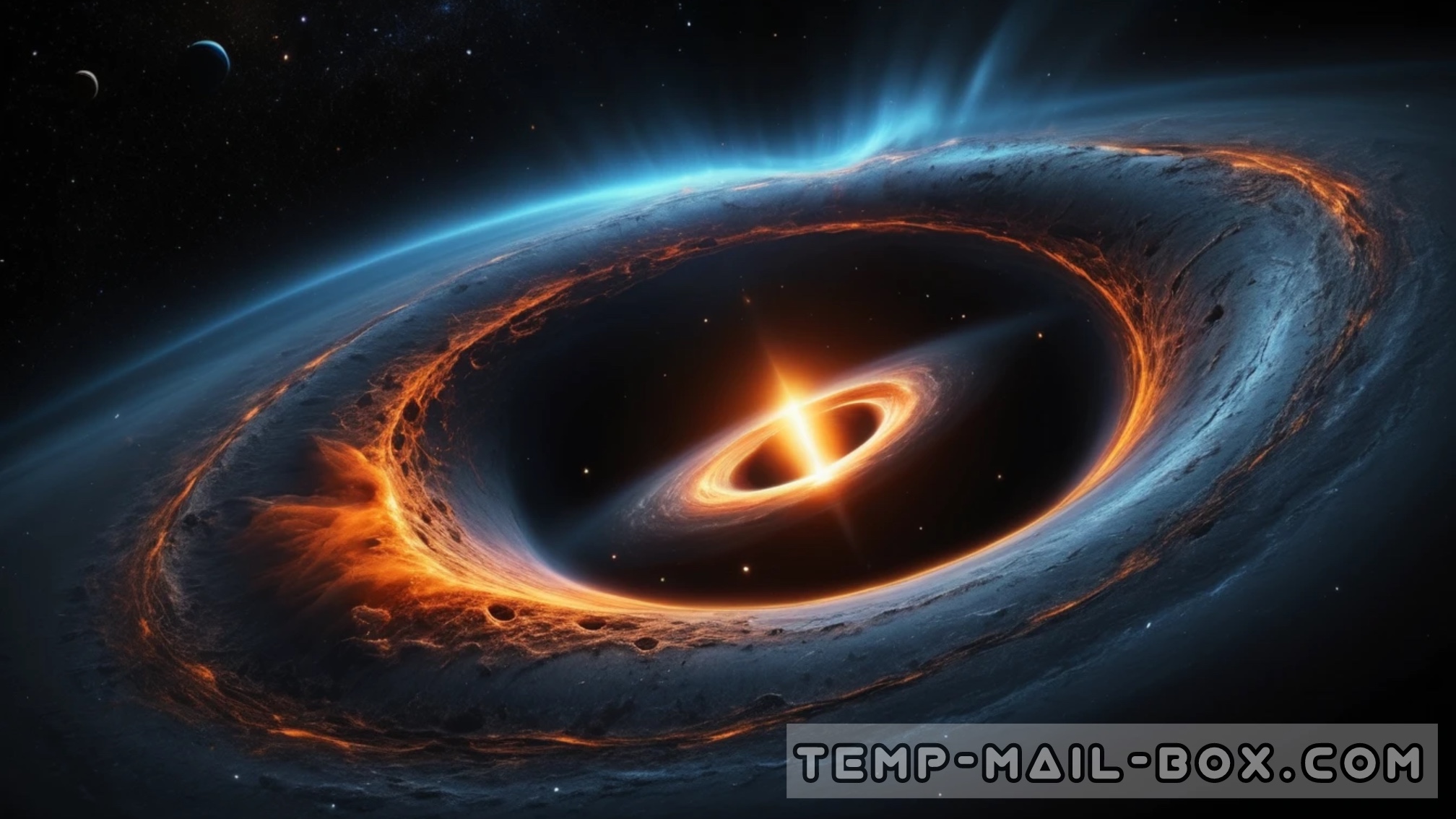
What Happens to Time Near a Black Hole?
Black holes are among the most extreme objects in the universe, and their effects on space and time challenge everyday intuition. Near a black hole, time itself behaves in ways that seem almost impossible, revealing the strange consequences of Einstein’s theory of relativity.
According to general relativity, gravity is not just a force pulling objects together; it is a curvature of spacetime caused by mass and energy. The stronger the gravity, the more spacetime bends. Black holes, formed from collapsed massive stars or through cosmic processes, create the most intense gravitational fields known. As a result, they dramatically affect the flow of time.
One of the key effects is gravitational time dilation. To a distant observer, a clock near a black hole appears to tick more slowly. The closer an object gets to the black hole, the stronger this effect becomes. Near the event horizon—the boundary beyond which nothing can escape—time appears to slow almost to a standstill from the perspective of someone far away.
For an observer falling toward the black hole, however, time feels normal—at least initially. Their own clock ticks as usual, and their physical processes proceed normally. This contrast highlights an important idea in physics: time is not absolute. Different observers can experience time at very different rates depending on gravity and motion.
At the event horizon, perspectives diverge dramatically. A distant observer would never actually see an object cross the horizon; instead, it would appear to freeze and fade due to extreme time dilation and gravitational redshift. For the falling observer, crossing the horizon happens in a finite amount of time, with no special marker signaling the boundary.
Beyond the event horizon lies a region where current physics struggles to provide clear answers. Near the center, or singularity, spacetime curvature becomes infinite according to classical theory. In this realm, our understanding of time breaks down completely, suggesting the need for a theory that unites general relativity and quantum mechanics.
The study of time near black holes is not just theoretical curiosity. Observations of stars orbiting supermassive black holes and measurements of gravitational waves confirm that time dilation is real and measurable. These findings help scientists test fundamental laws of physics under extreme conditions.
Ultimately, black holes reveal that time is flexible, not fixed. Near these cosmic giants, seconds can stretch, moments can freeze, and the familiar flow of time becomes a profoundly relative experience—reshaping how we understand the universe itself.