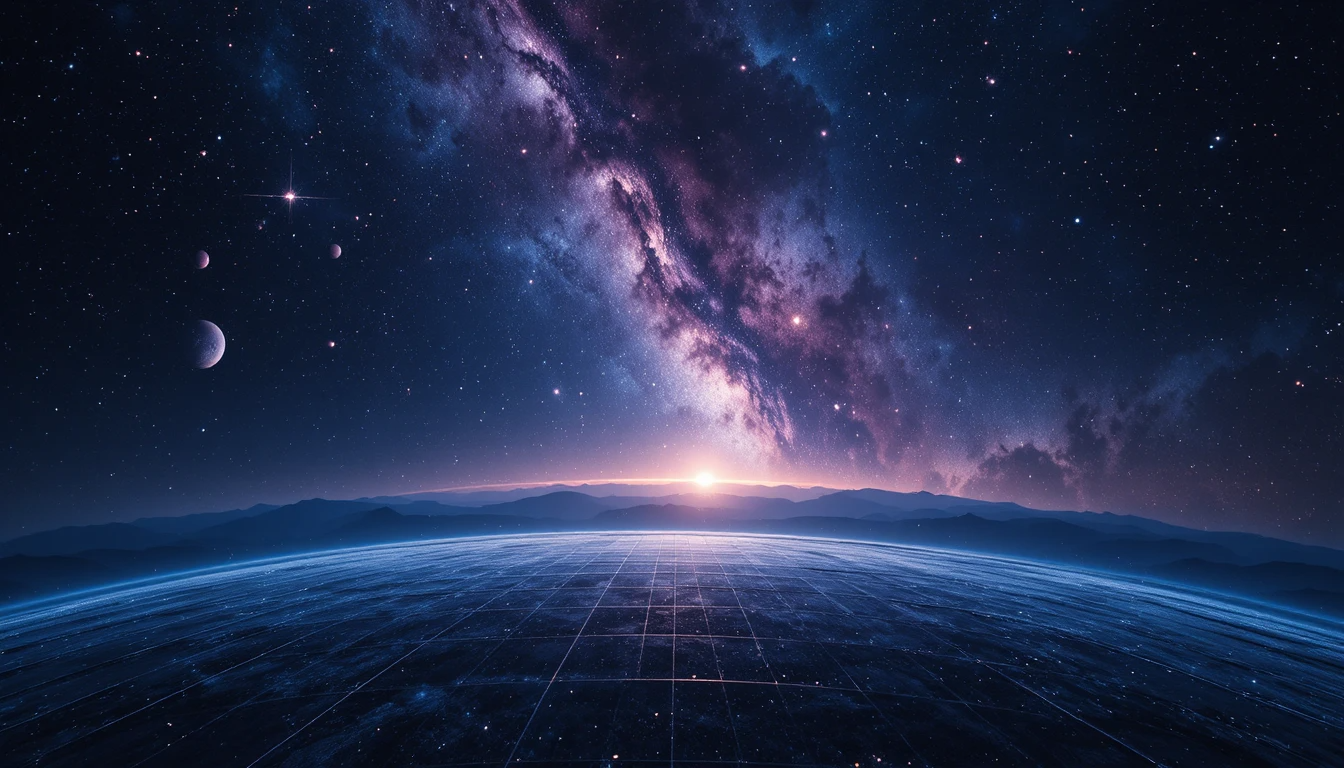
Can the Universe Have an Edge? What Scientists Think
The idea of reaching the “edge” of the universe is one of the most fascinating questions in cosmology. It sounds simple: if the universe exists, does it have a boundary? But modern physics suggests that the answer is far more complex than our everyday intuition allows.
First, scientists distinguish between the observable universe and the entire universe. The observable universe includes everything whose light has had time to reach us since the Big Bang. Because light travels at a finite speed and the universe has a finite age, we can only see a limited region. This creates a kind of “cosmic horizon,” but it is not a physical wall—just a limit to what we can observe.
Beyond this horizon may lie vastly more space, possibly infinite. Current cosmological models based on general relativity and observations of cosmic background radiation suggest that the universe is expanding. Importantly, it is not expanding into empty space; rather, space itself is stretching. This makes the concept of an outer edge difficult to define.
Scientists consider several possibilities regarding the universe’s shape. It could be flat, extending infinitely in all directions. It might be closed, similar to the surface of a sphere but in three dimensions—finite in volume yet without an edge. Or it could be open, curved in a way that expands forever. Current measurements strongly support a nearly flat universe.
If the universe were closed and curved back on itself, traveling in one direction long enough could theoretically bring you back to your starting point, without ever encountering a boundary. In this scenario, asking about the edge is like asking where the edge of Earth’s surface is—you can keep moving, but you never fall off.
Another intriguing idea is that the universe might be part of a larger multiverse. In some inflationary models, our universe could be just one “bubble” among many. However, such theories remain speculative and difficult to test experimentally.
Ultimately, no current evidence suggests that the universe has a physical edge like a wall or border. Instead, the limits we perceive are tied to observation, not structure. The universe may be finite or infinite, curved or flat, but the concept of an edge likely does not apply in the way we imagine.
The question of whether the universe has an edge challenges not only physics but also human imagination. As observations improve and theoretical models evolve, scientists continue to refine their understanding. For now, the best answer is that the universe appears boundaryless—at least in any way we can measure.